


America's public schools are confronting a leadership challenge that extends far beyond the superintendent's office. While recent national attention has focused on the shrinking superintendent pipeline, the same pressures are affecting assistant superintendents, executive directors, principals, and other district leaders who form the backbone of educational systems (Batty, 2026; DeMatthews et al, 2024; Peurach et al, 2025; Toppo, 2023).
A recent analysis by The 74 Million described the superintendent pipeline as “running dry,” noting that increasing complexity, political pressures, and expanded responsibilities have made executive leadership more difficult than ever (Schoales, 2026). The article raises an important question for school boards seeking future superintendents. An equally important question, however, is one that districts themselves are asking every day: how do we intentionally build leadership capacity across the entire organization before vacancies occur?
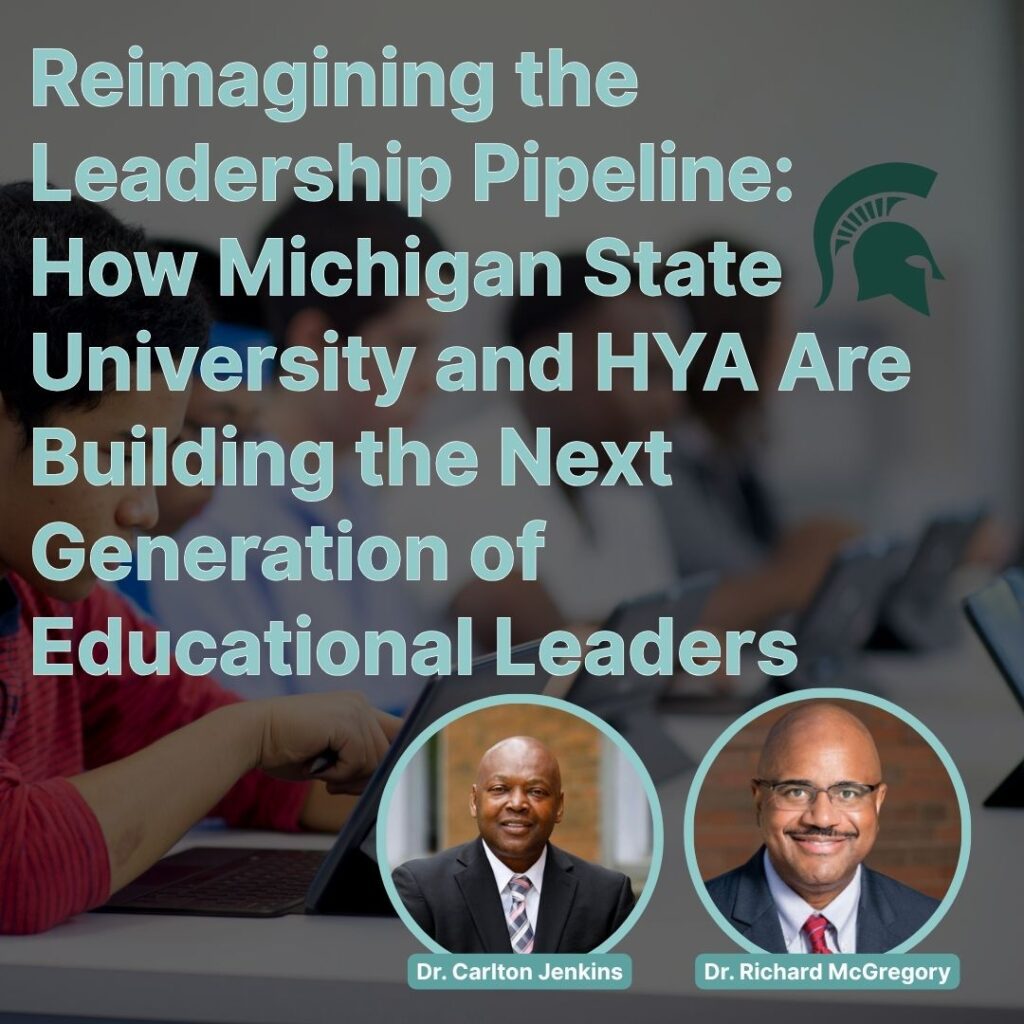
During conversations with school districts across the country, Michigan State University (MSU) and HYA repeatedly heard the same concern. Superintendents were not simply seeking succession plans for executive positions; they wanted meaningful professional learning opportunities that would strengthen the leadership capacity of building administrators, central office leaders, aspiring executives, and experienced practitioners alike. Those conversations became the catalyst for the Michigan State University/HYA Practitioner Learning Academy. In this article, Dr. Carlton D. Jenkins and Dr. Richard McGregory Jr. argue that the nation’s educational leadership challenge extends well beyond superintendent vacancies and requires school systems to intentionally cultivate leadership talent at every level.
A Different Model for Leadership Development
Traditional leadership preparation often emphasizes theory, compliance, or credential attainment (Base & Abad, 2025; Peng et al, 2024). While these elements remain important, today’s leaders consistently report needing something different: learning that is immediately applicable, practitioner-driven, collaborative, and responsive to today’s rapidly changing educational environment (Jassim, 2024). The Academy was intentionally designed around those needs.
Rather than focusing solely on academic coursework, participants engage in an immersive learning experience led by nationally recognized practitioners, university faculty, and current educational leaders. Sessions emphasize authentic problems of
practice, strategic thinking, organizational leadership, and collaborative problem solving—all grounded in the realities facing today’s schools.
The broader vision is to prepare leaders who can navigate issues such as:
- Artificial intelligence and emerging technologies; accelerating opportunities and wrestling with the ethical dilemmas
- Strategic resource generation and fiscal stewardship
- Political governance and board relations
- Community engagement and stakeholder communication
- Talent recruitment and leadership development
- Data-informed decision making
- Literacy and instructional leadership
- Organizational change and systems thinking
These leadership domains were intentionally designed to align with nationally recognized leadership competencies while reflecting the increasingly interdisciplinary nature of educational leadership.
From Concept to Proof of Practice
Every innovative idea requires validation. During Spring 2026, Michigan State University and HYA launched the Academy as a proof-of-concept cohort. The objective was straightforward. Discover whether an online, practitioner-focused leadership academy could meaningfully strengthen the capacity of educational leaders while creating a professional learning community that participants would value.
The answer was a resounding yes. Participants consistently described the Academy as transformative—not simply because of the content, but because of the opportunity to learn alongside accomplished colleagues and nationally respected practitioners.
One participant summarized the experience:
“The Michigan State University Practitioner Learning Academy was an exceptional professional learning experience that strengthened my leadership practice, expanded my network, and deepened my understanding of the complex work of school system leadership.”
Another participant reflected on the Academy’s practical impact: “It provided me with physical and digital resources that I will need in order to advance in the educational
system… This was an amazing experience that has truly empowered me toward taking the next steps toward district leadership.”
Others emphasized perhaps the Academy’s greatest strength—the professional relationships created among participants. One participant described gaining “trusted thought partners” while developing practical leadership strategies that increased confidence and clarity in addressing complex educational challenges.
Guest faculty also recognized the exceptional level of engagement. As one Academy presenter observed: “…participants were willing to ask difficult questions, challenge assumptions, and wrestle with the realities of leadership in increasingly complex organizations.”
Building Leadership Capacity Across Entire Organizations
Perhaps the Academy’s most distinguishing characteristic is its recognition that educational leadership is not confined to one office. High-performing school systems require strong leadership throughout the organization. Assistant principals become principals. Principals become executive directors. Executive directors become assistant superintendents. Assistant superintendents become superintendents.
Preparing leaders only after vacancies occur is increasingly insufficient. Instead, districts need intentional leadership development systems that cultivate talent before transitions become urgent.
The Academy was designed precisely for this purpose—developing leaders at multiple organizational levels while helping districts strengthen succession planning and organizational capacity.
Practitioner Expertise Meets University Excellence
The Academy represents a distinctive partnership between Michigan State University’s College of Education and HYA. Michigan State contributes its nationally recognized scholarship, research expertise, and commitment to preparing educational leaders. HYA contributes decades of practitioner expertise in executive leadership, superintendent searches, governance, strategic planning, and organizational consulting. Together, the partnership creates a learning environment where research informs practice, and practice continuously informs research.
The long-term vision extends beyond a single academy. The partnership proposes an evolving ecosystem of online micro-credential programs, practitioner learning
experiences, executive coaching, sponsored projects of practice, and research dissemination designed to keep educational leaders current throughout their careers.
Looking Ahead
Building upon the success of the Spring 2026 pilot, Michigan State University and HYA are expanding the Academy through the Fall 2026 cohort. The fully-online format continues to accommodate the demanding schedules of practicing administrators while preserving the highly interactive learning environment that participants praised during the inaugural offering.
The Academy also introduces collaborative projects connecting participants with education partners to examine authentic district challenges and develop solutions grounded in practice. Sponsors gain valuable insight into district priorities while participants engage in applied leadership experiences that mirror executive decision making.
Leadership Development as a National Imperative
The national conversation about educational leadership should not focus solely on replacing retiring superintendents. Instead, it should focus on building sustainable leadership systems. When districts intentionally develop leaders throughout their organizations, they increase organizational resilience, strengthen succession planning, improve decision making, and ultimately enhance student outcomes. The Spring 2026 MSU/HYA Academy demonstrated that practitioner-centered leadership development can successfully address this need.
As educational leadership continues to grow more complex, universities and practitioners have an opportunity, and arguably a responsibility, to rethink how leaders are prepared. The future of educational leadership will depend less on finding exceptional individuals and more on building exceptional systems that intentionally cultivate leadership talent at every level. The Michigan State University/HYA Practitioner Learning Academy represents one promising step toward that future.
Interested in Learning More?
As school districts continue to navigate educator shortages, leadership transitions, increasing instructional demands, and school improvement initiatives, developing a strong leadership pipeline has never been more important. The Practitioner Leadership Learning Academy was created to help districts build leadership capacity by preparing aspiring and emerging leaders to effectively address today’s complex educational challenges while positioning them for future leadership opportunities.
Through a rigorous, research-based curriculum led by experienced educational leaders and university faculty, participants will strengthen their instructional leadership practices, develop strategic decision-making skills, foster collaborative school cultures, and build the organizational leadership competencies necessary to improve teaching and learning. The academy directly supports district priorities related to leadership succession planning, instructional excellence, educator recruitment and retention, continuous school improvement, and organizational effectiveness.
References
Base, R., & Abad, R. (2025). A Conceptual Framework for Preparing 21st-Century School Leaders: Aligning Qualification Standards with the Evolving Role of the Principal. International Journal, 5(01).
Batty, E. K. (2026). K-12 Leaders and Their Successful Transitions to School Change (Doctoral dissertation, Grand Canyon University).
DeMatthews, D., Aylward, A., Knight, D., & Reyes, P. (2024). Understanding the superintendent pipeline: A call for a national longitudinal dataset. Educational Researcher, 53(3), 184-187.
Jassim, S. (2024). Educational innovation and leadership: Shaping the future of learning. Academy of Educational Leadership Journal, 28(2), 1-3.
Peng, T., Wang, C., Xu, J., Dai, J., & Yu, T. (2024). Evolution and Current Research Status of Educational Leadership Theory: A Content Analysis-Based Study. Sage Open, 14(3).
Peurach, D. J., Jones, E. S., Duff, M., Sherer, J. Z., & Matthis, C. (2025). The practice and contexts of hub and district leadership: New directions in research on educational improvement networks. Peabody Journal of Education, 100(1), 117-132.
Schoales, V. (2026). The big-district superintendent pipeline has run dry. What can school boards do? The 74 Million
Toppo, G. R. E. G. (2023). School superintendents head for the exits. Education Next, 23(1), 28-34.