


"Representation allows children to see possibilities for themselves, but its impact extends beyond simply seeing someone who looks like them."
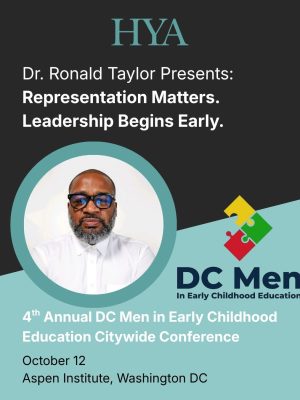
By Dr. Ronald G. Taylor
In education, we often talk about the importance of preparing students for leadership. We talk about developing confidence, building character, fostering academic achievement, and helping young people envision a future filled with possibility. But leadership development does not begin when a student enters a leadership program, runs for student council, or eventually takes on a professional title.
Leadership begins much earlier
It begins with the adults children encounter in their earliest years. It begins with the relationships that help children understand who they are, what they are capable of, and whether they belong. And it begins when children see people from different backgrounds and experiences serving as teachers, mentors, caregivers, and leaders.
For Black boys in particular, representation can play a meaningful role in expanding their understanding of what is possible.
Long before I became a principal, superintendent, executive coach, or author, I was a Black boy whose life could have taken a very different path. Growing up amid significant family and economic challenges, including witnessing the struggles of an abused mother, I learned early that circumstances can shape a child, but they do not have to determine that child’s future.
Education changed mine
Years later, I began my career as an early childhood educator working with young children facing significant economic and social barriers. I quickly learned that before I could ask children to achieve academically, I had to help them believe they were capable of achieving. That meant building self-esteem, creating a sense of belonging and connection, establishing high expectations, and making certain every child knew they mattered.
That lesson never left me
As a principal, I worked to build a school culture grounded in belonging, relationships, shared responsibility, and high expectations, and watched those foundations contribute to stronger academic outcomes. Later, as a superintendent, those same principles informed how I approached leadership, opportunity, and educational equity.
This is why the presence of Black men in early childhood education matters so deeply. Representation allows children to see possibilities for themselves, but its impact extends beyond simply seeing someone who looks like them. Black male educators can challenge assumptions about who teaches, who nurtures, who leads, and who belongs in the lives of young children.
My journey—from student, to early childhood educator, to principal, to superintendent—continues to remind me that leadership begins long before someone receives a title. Sometimes it begins when an educator looks at a child, recognizes possibility, and creates the conditions for that possibility to flourish.
Representation Matters
A child’s earliest educational experiences can shape how they see themselves as learners, community members, and future leaders. The educators they encounter become part of that experience, not only through what they teach, but through what they model.
For Black boys, seeing Black men working as early childhood educators can broaden their understanding of what is possible. It can challenge assumptions about who teaches, who nurtures, and who leads. And representation benefits all students by exposing them to educators with diverse identities, experiences, and perspectives.
But representation requires intentionality. If school systems want to attract and retain more diverse educators, they must create pathways into the profession, provide meaningful mentorship and support, and build cultures where educators from all backgrounds can thrive.
That is an important responsibility that all educational leaders hold.
Leadership Begins Early
Ronald Taylor’s journey illustrates a larger truth about educational leadership: some of the most important acts of leadership happen long before a title is involved.
A teacher who helps a child believe in their own potential is leading. A principal who creates a culture of belonging is leading. A superintendent who works to expand opportunity is leading.
When educators create environments where children feel valued, capable, and seen, they are doing more than supporting academic success. They are helping shape the leaders those children may one day become.
Sometimes, that begins with something as simple and as powerful as a child seeing an adult who makes a possibility feel real.
Hear more about Dr. Taylor’s journey at the 4th Annual DC Men in Early Childhood Education Citywide Conference on October 12, 2026, at the Aspen Institute in Washington, DC.